

Benedetta is a 2021 historical drama directed by acclaimed Dutch filmmaker Paul Verhoeven. Set in 17th-century Tuscany, Italy, the film tells the controversial story of Benedetta Carlini, a young nun whose religious visions, claims of miracles, and forbidden relationship with another woman disrupt the life of a convent and attract the attention of powerful figures within the Catholic Church.
Starring Virginie Efira as Benedetta, alongside Charlotte Rampling, Daphné Patakia, and Lambert Wilson, the film combines historical drama, psychological tension, eroticism, and religious controversy. It explores the complicated relationship between faith and desire, questioning how religious authority can be influenced by ambition, politics, personal belief, and the pursuit of power.
Inspired by Judith C. Brown’s historical study Immodest Acts: The Life of a Lesbian Nun in Renaissance Italy, Benedetta draws on the real-life story of Benedetta Carlini, a 17th-century Italian nun. However, the film is a dramatic interpretation rather than a strictly documentary account.
Selected to compete for the Palme d’Or at the 2021 Cannes Film Festival, Benedetta attracted considerable attention for its provocative subject matter and its unflinching examination of religious institutions, sexuality, and the meaning of divine revelation.
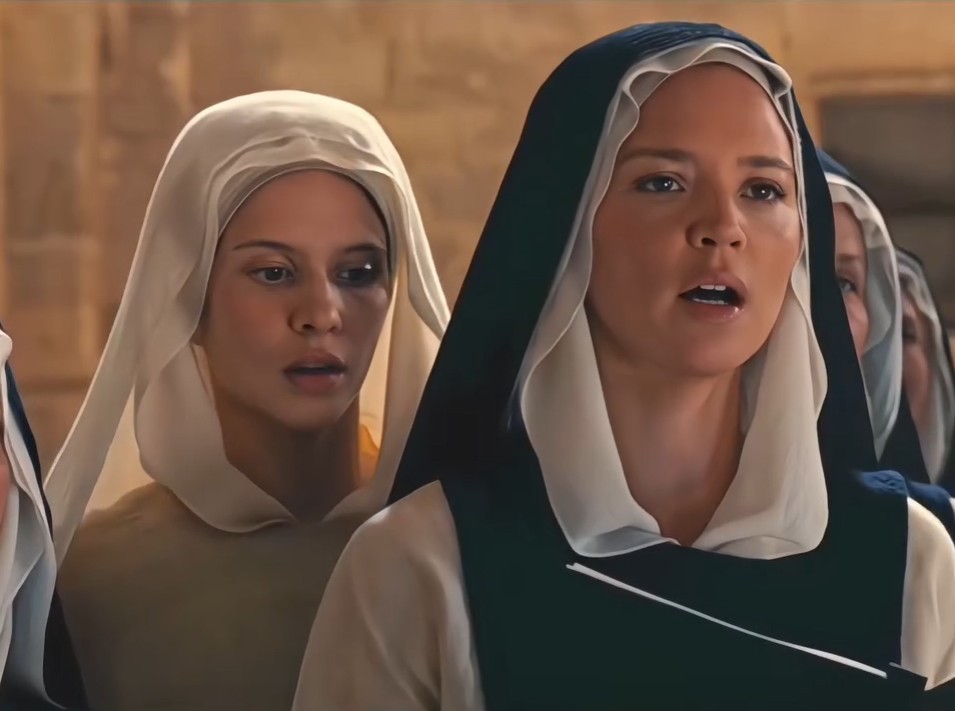
Movie Summary
The story begins in late 17th-century Italy, during a period when plague and religious uncertainty are spreading across the country. As a young girl, Benedetta Carlini travels with her parents to the convent in Pescia, Tuscany, where she is to begin a religious life. Even at this early age, she appears to possess an unusual spiritual sensitivity. Her journey to the convent includes an encounter that suggests her faith may be accompanied by something extraordinary.
Years later, Benedetta has grown into a devoted nun whose intense religious experiences begin to attract attention within the convent. She experiences visions of Jesus and believes that she has a special connection with the divine. Her claims gradually become more significant when she develops physical wounds resembling the stigmata of Christ.
For some members of the religious community, these events suggest that Benedetta has been chosen for a remarkable spiritual purpose. For others, they create suspicion and raise uncomfortable questions about the authenticity of her experiences. In an institution where religious authority carries enormous influence, the distinction between genuine faith and calculated deception becomes increasingly important.
The arrival of Bartolomea, a young woman seeking refuge from an abusive home, changes Benedetta’s life. Bartolomea is placed under the care of the convent, where she becomes closely involved with Benedetta. The two women develop an intense emotional and physical relationship that challenges the strict rules governing their religious lives.
Their growing intimacy takes place against a background of religious devotion, secrecy, and institutional control. Benedetta’s visions become more dramatic, while her relationship with Bartolomea creates a serious threat to her position within the convent. The same experiences that elevate her status also make her vulnerable to accusations and investigation.
As Benedetta’s influence grows, she eventually rises to a position of considerable authority within the convent. Her spiritual reputation attracts attention beyond its walls, bringing her into conflict with people who have their own interests in the Church’s hierarchy. The arrival of the papal representative introduces another layer of political and religious tension.
The investigation into Benedetta’s behavior becomes increasingly complicated. Her claims of divine visions, the wounds on her body, and her relationship with Bartolomea are all examined as questions of faith, morality, and possible deception. Those involved must decide whether Benedetta is a genuine religious visionary, a woman driven by extraordinary desires, or someone using the power of belief to secure her position.
As the conflict reaches its climax, Benedetta reveals how religion, sexuality, politics, and personal ambition can become intertwined. The film leaves viewers questioning the nature of miracles, the motives behind religious authority, and the price paid by people who challenge the established order.
Star Cast
- Virginie Efira as Benedetta Carlini – The central character, a nun whose visions and apparent miraculous experiences bring her fame and authority within the convent. Her relationship with Bartolomea becomes the source of a major religious scandal.
- Charlotte Rampling as Sister Felicita – The experienced abbess of the convent. She is responsible for maintaining order within the religious community and becomes increasingly concerned about Benedetta’s influence.
- Daphné Patakia as Bartolomea – A young woman who arrives at the convent seeking protection from an abusive family situation. Her relationship with Benedetta develops into a forbidden romance.
- Lambert Wilson as the Papal Nuncio – A representative of the Catholic Church who becomes involved in the investigation surrounding Benedetta and her extraordinary claims.
- Olivier Rabourdin as Alfonso Cecchi – A religious authority involved in the examination of Benedetta’s visions and alleged miracles.
- Louise Chevillotte as Sister Christina – A young nun whose position within the convent is affected by Benedetta’s growing influence.
- Hervé Pierre as Paolo Ricordati – A supporting character connected to the religious and political events surrounding the convent.
- Clotilde Courau as Midea Carlini – Benedetta’s mother, who appears in the early part of the story.
- David Clavel as Giuliano Carlini – Benedetta’s father, who brings her to the convent as a child.
What Makes Benedetta Worth Watching?
A Controversial Story Inspired by Real Events
One of the most distinctive aspects of Benedetta is its connection to an actual historical figure. Benedetta Carlini lived in 17th-century Italy and became known for her religious visions and claims of experiencing the stigmata.
The film takes inspiration from historical research into her life, particularly Judith C. Brown’s book Immodest Acts. It transforms this unusual historical account into a dramatic exploration of faith, sexuality, and institutional power.
Although the movie includes fictionalized elements, its historical foundation gives the story an additional layer of intrigue. The audience is encouraged to consider how much of Benedetta’s reputation came from religious conviction, personal ambition, or the political circumstances of her time.
The Complex Relationship Between Faith and Desire
At the heart of the film is the conflict between Benedetta’s religious devotion and her relationship with Bartolomea. Both women live in an environment governed by strict spiritual and moral expectations, making their growing intimacy particularly dangerous.
Rather than treating religion and sexuality as completely separate subjects, the film places them in direct confrontation. Benedetta’s visions are deeply personal, but they also become a source of public authority. Her private desires and public religious identity increasingly influence one another.
Paul Verhoeven’s Provocative Direction
Director Paul Verhoeven is known for films that challenge conventional expectations and explore uncomfortable aspects of human behavior. In Benedetta, he applies that approach to a historical setting shaped by religious hierarchy and social restrictions.
The film does not present its central character as an uncomplicated saint or villain. Instead, Benedetta remains an ambiguous figure whose actions can be interpreted in different ways. This uncertainty gives the story much of its psychological tension.
Strong Performances from the Cast
Virginie Efira delivers a demanding performance as Benedetta, portraying a character whose religious experiences, personal desires, and ambitions are difficult to separate.
Daphné Patakia provides an important emotional counterpoint as Bartolomea, while Charlotte Rampling brings restraint and authority to the role of Sister Felicita. Lambert Wilson adds another dimension through his portrayal of the Church’s institutional power.
The performances help create a dramatic atmosphere in which even seemingly private decisions can have serious consequences.
A Visually Rich Historical Setting
The film recreates the atmosphere of a 17th-century Italian convent through its costumes, interiors, religious imagery, and carefully composed cinematography.
The contrast between the beauty of the convent and the strict rules governing its inhabitants is particularly effective. Religious ceremonies, quiet rooms, and imposing architecture reinforce the feeling that the characters live within a world where faith and authority shape almost every aspect of daily life.
A Bold Examination of Religious Authority
Beyond its romantic and historical elements, Benedetta is also a story about power. Benedetta’s visions give her an unusual position within the convent, but that influence attracts jealousy, suspicion, and political attention.
The film examines how religious institutions respond when someone claims a special relationship with God. It also raises questions about who has the authority to decide whether an experience is a miracle, a deception, or something that cannot be easily explained.
Movie Details
| Category | Information |
|---|---|
| Movie Title | Benedetta |
| Release Year | 2021 |
| Genre | Historical Drama, Biography, Romance |
| Country | France, Netherlands, Belgium |
| Language | French |
| Director | Paul Verhoeven |
| Screenplay | David Birke, Paul Verhoeven |
| Based On | Immodest Acts by Judith C. Brown |
| Cinematography | Jeanne Lapoirie |
| Music | Anne Dudley |
| Editing | Job ter Burg |
| Main Cast | Virginie Efira, Charlotte Rampling, Daphné Patakia, Lambert Wilson, Olivier Rabourdin |
| Runtime | Approximately 131 minutes |
| World Premiere | July 9, 2021 |
| Festival | 2021 Cannes Film Festival – In Competition |
| Production Companies | SBS Productions, Pathé, France 2 Cinéma, France 3 Cinéma, Topkapi Films, Belga Productions |
Where to Watch Benedetta (2021)
Benedetta received an international theatrical release and was subsequently distributed through selected digital platforms and video-on-demand services.